


We’re not talking about caring for major appliances here—the refrigerators, dishwashers, and washing machines which make our lives easier. We’re talking about much smaller scale appliances which produce major results for our oral care—the dental appliances which give us healthier, more attractive smiles!
A dental appliance is simply any device which helps promote dental health. And while that definition is awfully broad, you still might be surprised at the many types of dental work which qualify! Today, we look at “fixed” appliances. These restorations or devices stay in the mouth, unlike removeable appliances like mouthguards and aligners. How do they work for us, and how do we provide the care they need to work effectively?
Fillings, Crowns, and Dental Implants
Dental restorations such as crowns and fillings, which protect the structure of your teeth, are considered appliances. So are dental implants. Implants use a post surgically implanted in the bone to act as the tooth’s “root.” When the post has fused with the bone, a crown is bonded to the implanted post for a tooth which functions—and looks—like your natural teeth.
- Cleaning—Clean your restorations and implants just like you would your natural teeth. This means brushing at least twice each day for two minutes and flossing once each day to protect both your dental work and your oral health.
- Diet—While restorations allow you to eat normally, it’s best to treat both your natural teeth and your restorations with care. Hard foods can crack or damage enamel, implants, and restorations. Chewy, sticky foods like caramels can dislodge restorations.
Fixed Orthodontic Appliances
If you or your child are in orthodontic treatment, you know that taking good care of orthodontic appliances will help treatment progress as quickly and comfortably as possible. Traditional braces and functional appliances like palatal expanders and the Herbst® and Forsus™ appliances are commonly used to help patients achieve their best smiles. Because these appliances stay in the mouth until treatment is complete, caring for them can present some day-to-day challenges.
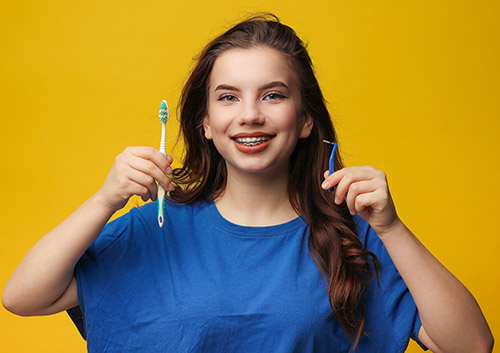
- Cleaning—You might need to brush and floss after every meal and snack to prevent plaque buildup and to keep food particles from sticking to braces and/or functional appliances. Your orthodontist will provide instructions for daily cleaning routines.
- Helpful tools—Interproximal brushes, flosses designed for braces, and water flossers can make cleaning teeth and appliances easier and more effective. Talk to your dental team at Robson Dentistry to learn the best tools and techniques for your specific needs.
- Diet—Sticky, chewy, hard, and crunchy foods are not on the menu when you have a fixed appliance! Sticky and chewy foods like caramels can damage appliances and are difficult to clean from appliances and enamel. Hard foods require biting pressure which can damage appliances—and your teeth! Crunchy foods can leave hard little particles stuck in and under appliances. Your orthodontist has all the details on choosing foods which are good for your teeth and your orthodontics.
- Stick to your orthodontic routine—Keeping up with your appointments and adjustments keeps your treatment on track and allows your orthodontist to discover any problems with your appliances. If you have any concerns about an appliance, it’s always a good idea to call your orthodontist’s office immediately.
Bridges
Bridges complete smiles when a tooth or teeth are missing, enabling normal speaking, biting, and chewing. Bridges also help prevent the remaining teeth from shifting out of place.
To create a custom bridge, a prosthetic tooth or row of teeth are attached to crowns placed on adjacent natural teeth, or attached with wings bonded to adjacent natural teeth, or secured to carefully placed implant posts. The type of bridge your dentist recommends will depend on your preferences, the health of your surrounding teeth, and the number and location of the missing teeth.
- Cleaning— Because the artificial teeth in the bridge are often connected to each other and/or to surrounding teeth, typical flossing between teeth isn’t always possible. Special flosses, interproximal brushes or water picks can make sure the areas under the bridge and adjacent to your natural teeth are free of plaque and food particles. Dr. James Robson can recommend the best tools and techniques.
- Diet—A bridge-friendly diet is a lot like a healthy orthodontic diet. Avoid hard and chewy foods like nuts and caramels which can damage or loosen your bridge. Foods like corn on the cob, tough meats, hard breads, and apples require more biting force, which can loosen a bridge over time. Cutting foods into smaller pieces and choosing softer food options will help extend the life of your bridge. Your dental team in East Lyme, CT is a great source of information on the healthiest diet for you and your dental work.
Implant-Supported Dentures
Permanent, fixed dentures remain in the mouth, anchored by implant posts strategically placed in the jaw. Like individual implant posts, these are placed surgically and require time to heal. When the posts have fused with the bone, an individually crafted denture is secured to them.
- Cleaning—Once the dentures are secured to the posts, brush and floss as you would with your natural teeth. A water flosser is helpful for cleaning under and around the denture.
- For best maintenance, Dr. James Robson can remove your denture for professional cleaning as needed.
- Once you have become used to your dentures, you can eat normally (although it’s best to avoid small, crunchy particles which can get trapped under the denture).
So many appliances, helping us protect our dental health and comfort in so many ways! And there are a few additional steps we can take to make sure these appliances perform at their best:
- Watch out for destructive dental habits. Nail biting, chewing on pencils or other objects, using teeth as tools to open bags or bottle caps, crunching on ice—any behaviors which can damage teeth can also damage appliances.
- Keep up with regular dental exams. Dr. James Robson can assess the health of your teeth and gums as well as the condition of your appliances.
- Don’t ignore problems! Call your dental team at once if you notice any damage to your teeth or appliances.
Fixed appliances make our lives better. They improve oral health, allow us to eat and speak without difficulty, and create confident smiles. With conscientious care, your appliances will continue to work both comfortably and effectively.
 Website Powered by Sesame 24-7™